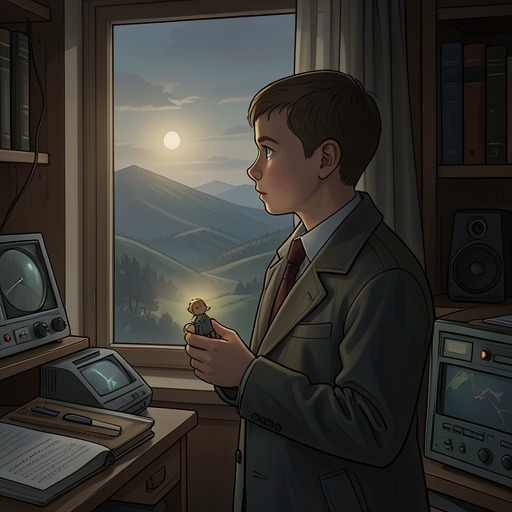
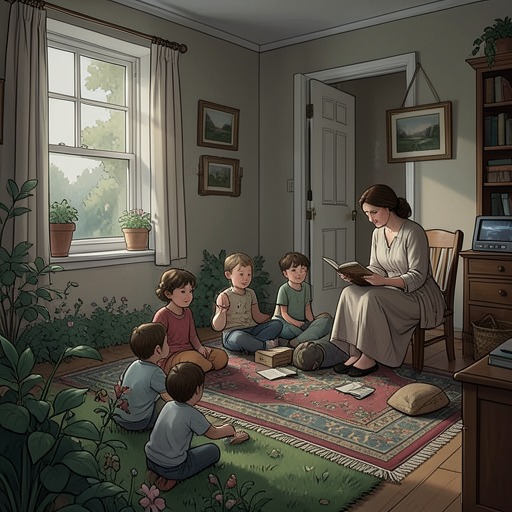
Winter 1898
Birth in Belfast
[C. S. Lewis](entity:character-recall-character-c-s-lewis-be3529485712) was born in [Belfast](entity:location-recall-location-belfast-8a60016bc9a1), where his father was a lawyer and his mother was the daughter of a pastor; he was about three years younger than his older brother. The personalities of his parents were vastly different: his father was emotionally expressive and skilled in speech, while his mother's
Before Lewis was six
The Toy Garden
Liu Yi's brother made a miniature garden using cookie boxes, moss, branches, and flowers. The real garden had not previously caught Liu Yi's attention, but this toy landscape made him feel early on the coolness, freshness, and vitality of nature. This image stayed with him, becoming a
Early childhood, before his mother’s death
First Glimpses of Joy
Several brief experiences made Lewis feel for the first time a stronger desire than ordinary pleasure. The memory of a toy garden reappeared beside a plant with flowering red elderberry; the book "The Wild Nutty" by Beatrix Potter made him think of the idea of autumn; and a line about the
1905
The Family Moves House
At seven years old, [Lewis's father](entity:character-recall-character-lewis-s-father-acb70b37975b) moved the whole family from the old house to a larger new house located further out in the suburbs of [Belfast](entity:location-recall-location-belfast-8a60016bc9a1). To the children, this place seemed like a city, with long corridors, empty rooms, attics, and the sounds of pipes and wind above the
Ages six to eight
Animal-Land Takes Shape
after repeatedly trying to make cardboard boats, houses and engines that he longed to create, but failing many times, Lewis began to write stories. he created in the attic study the chivalric mice and rabbits, then connected their medieval adventures with a modern animal kingdom; this animal kingdom was later linked
Around 1908
His Mother Falls Ill
About 1908, Liu Yi was suffering from a headache and toothache that night, and his mother was seriously ill. Doctors were talking in low voices around the house, and finally, his father came to tell this frightened boy what had happened: his mother had cancer
Around 1908, after a period of illness
His Mother Dies
After his mother's death, Lewis was taken to see her. The corpse he saw was neither beautiful nor comforting, but rather frightening; the public funeral ceremony and mourning attire also terrified him. This loss ended the secure happiness of his childhood. He and his brother drew closer to each other for protection
During his mother’s final illness
Prayers for a Miracle
Remember to pray with faith and it will be granted, Lewis struggled to convince himself that his mother would recover. After her death, he turned his hope to miracles; when miracles did not occur, he did not feel a greater religious crisis. Looking back, he realized he had prayed to God as a
September 1908
First Journey to School
In September 1908, Lewis and his brother sailed from [Belfast](entity:location-recall-location-belfast-8a60016bc9a1) to [England](entity:location-recall-location-england-b153c1f368ea) to begin their first term at a boarding school. Lewis was troubled by the stiff school uniform and thought the school would be like a prison; however, when the ship left Belfast Bay and the lights of his hometown gradually
1908–1910
Life at Belsen
At [Belsen](entity:location-recall-location-belsen-514c418e849c), Lewis encountered a small, poorly managed school, where the principal, Ordie, dominated everything. The boys endured arbitrarily scheduled classes, endless arithmetic, poor conditions, and strict physical punishment; Lewis remembered a boy named P who was whipped. The oppressive atmosphere of the school forced the boys
During his years at Belsen, 1908–1910
Faith Awakens at Belsen
The boys went to a church with a thick anglo-catholic style for worship. The flickering candles, incense, vestments, and the psalms sung kneeling all made Lewis feel strange; he also consciously resisted them. More importantly, he heard some obviously sincere Christians teaching the doctrines
Summer 1910
Belsen Ends
Orridy's school was gradually deteriorating and finally closed. Lewis experienced the last few years of chaos and neglect at the school before leaving. He remembered his academic failures, but also the friendship he shared with a few boys who had endured tough times together, and the geometry class that truly taught him
1910
A Short Stay at Campbell
At [Campbell College](entity:location-recall-location-campbell-college-6fa93665d6d8), Lewis found that the students came from different social classes, there were real fights and gangs on campus, and the freshman boys almost felt no warmth of home. Once, he was caught by a gang and thrown through a hatch into a coal bunker; it was alarming, but just a
Late 1910
A Solitary Christmas at Home
Due to illness and his father's change of plans, Lewis returned home after about half a semester at [Campbell College](entity:location-recall-location-campbell-college-6fa93665d6d8). Without his brother, he slept in his father's room to avoid the fear of solitary nights. After his father left for work, the empty house became his favorite refuge. Lewis read books
January 1911
Arrival at Chartres
At the age of thirteen, Lewis and his brother came to Huawen Town; his brother entered Huawen College, while Lewis began studying at the preparatory school [Chartres](entity:location-recall-location-chartres-ccb8fa33adf3). The teaching at Chartres was patient and attentive, and it was there that Lewis first made genuine friends among his peers
Early in Lewis’s time at Chartres, 1911–1912
Miss C. Introduces the Occult
The beloved matron [Miss C.](entity:character-recall-character-miss-c-3699fd68a548) spoke to Lewis about Theosophy, Spiritualism, and other occult interests while sincerely searching for spiritual truth herself. Her conversations introduced him to the possibility that hidden marvels and unseen realms might exist behind the visible world.
That prospect awakened a powerful appetite for the preternatural. Gradually, the speculative vagueness of occult ideas spread into his Christian beliefs, making the creed feel less like revealed truth and more like one option among many.
During Lewis’s years at Chartres
Prayer Becomes a Burden
Lewis’s attempt to pray attentively became trapped in an anxious cycle. After each prayer, he worried that he had not truly concentrated; he then repeated it, trying to force a vivid emotional realization that he could never reliably produce.
The nightly effort made bedtime a source of dread and projected its misery across his evenings. This mistaken spiritual discipline gave him an unconscious reason to want release from Christianity, even before he fully understood what was driving his doubts.
1911–1913
Doubts Turn into Apostasy
Classical study exposed Lewis to pagan religious ideas treated by teachers as natural nonsense, while Christianity alone was presented as a true exception. He could not see why it deserved different treatment. Meanwhile, he regarded the universe as wasteful and hostile, and his childhood frustrations with clumsy hands helped form an expectation that things resisted him.
Occult speculation, pessimism, and the desire to escape the burdens of prayer converged. By the time he left [Chartres](entity:location-recall-location-chartres-ccb8fa33adf3), he had quietly abandoned Christian belief with relief rather than grief, though the process had been gradual and its precise chronology uncertain.
Middle of Lewis’s time at Chartres
Pogo’s Sophistication
After [Miss C.](entity:character-recall-character-miss-c-3699fd68a548) and a much-loved master left [Chartres](entity:location-recall-location-chartres-ccb8fa33adf3), [Pogo](entity:character-recall-character-pogo-865e01f45b4e) became an influential young teacher. Lewis and other boys copied his fashionable clothes, theatrical interests, jokes, and air of knowing the adult world.
Lewis later distinguished this influence from the sexual temptations of adolescence: Pogo chiefly drew him toward vanity, swagger, and social distinction. Lewis began trying to make himself a fop and snob, while the school’s decline left the earlier warmth and moral influence diminished.
Early in the Chartres years
The Wagnerian Vision
A literary headline about Siegfried and the Twilight of the Gods, paired with an [Arthur](entity:character-recall-character-arthur-2e33b65bbe57) Rackham illustration, suddenly awakened Lewis’s dormant imaginative longing. He recognized the same northern atmosphere he had felt in the Balder poem: vast twilight spaces, severity, distance, and a bittersweet desire that seemed to come from beyond ordinary life.
The vision revived his memory of [Joy](entity:expression-recall-expression-joy-07db2f6b3a9f) and made him desperate to encounter it again. A succession of opera synopses and [gramophone](entity:object-recall-object-69029499b0cd) records drew him deeper into the world of Wagner, and he began an ambitious poem about the Niblung story.
After the first vision, during 1912–1913
Wagner and the Northernness
Lewis listened to Wagner’s Ride of the Valkyries and began collecting recordings, treating the music as a new kind of experience rather than an ordinary pleasure. A visit to [Dundrum](entity:location-recall-location-dundrum-1004bd9dad39) let him see Rackham’s illustrated book, which he coveted until his brother shared its cost.
The Norse world seemed to Lewis to claim something like adoration, though he did not believe in its gods or accept any duties from it. He later wondered whether this imaginative attachment had schooled him in worship, even as it drew him away from Christianity.
During the Chartres years, after the Wagnerian awakening
Nature Joins the Vision
At first, Lewis read the landscape of the [Wicklow Mountains](entity:location-recall-location-wicklow-mountains-6391d27251f7) as scenery for Wagner’s stories, imagining where Siegfried, Mime, and Fafner might appear. Over time, nature itself became an independent medium of [Joy](entity:expression-recall-expression-joy-07db2f6b3a9f) rather than merely a reminder of literature and music.
He also immersed himself in Norse mythology and became knowledgeable about its sources. The intellectual satisfaction of learning the myths slowly began to replace the original shock of longing, though Lewis did not yet recognize the difference.
During the Chartres years
Boxen Becomes a Kingdom
Lewis and his brother’s [Animal-Land](entity:location-recall-location-animal-land-3059eb5c194a) and India developed into the united country of [Boxen](entity:location-recall-location-boxen-a7dbd953def3), with its own kings, assembly, officials, and political history. Lewis later saw echoes of their family life in its characters, though he stressed that these resemblances emerged as the invented world matured.
The elaborate setting mattered to his development as a writer, but it remained distinct from [Joy](entity:expression-recall-expression-joy-07db2f6b3a9f). Boxen was a constructed world that its creators knew to be invented, not a reality they longed to reach.
Summer 1913
Scholarship to Wyvern
At the end of the summer term, Lewis won a classical entrance scholarship to [Wyvern College](entity:location-recall-location-wyvern-college-853e334ead65). The achievement ended his preparatory-school years and carried him into the public-school world he had long watched from the outside.
He arrived already longing for its [Bloods](entity:character-recall-character-bloods-df42993552dd), the athletes and prefects who held prestige and authority. His excitement about joining their world would soon collide with the realities of its hierarchy and compulsory routines.
Autumn 1913, on entering Wyvern
The Bloods’ Hierarchy
Lewis found that [Wyvern](entity:location-recall-location-wyvern-b01f4151ca3d)’s social order was governed by the [Bloods](entity:character-recall-character-bloods-df42993552dd), whose standing depended chiefly on athletic prowess, seniority, appearance, and conformity to school fashion. Prefects were drawn largely from the same group, combining social prestige with formal power.
The system made upward advancement seem more attractive to middle-ranking boys than collective resistance. Lewis initially approached the Bloods with awe, but the school’s elaborate hierarchy would become a central source of exhaustion and resentment.
The first years at Wyvern
The Fagging System
Junior boys formed a common labor pool for the [Bloods](entity:character-recall-character-bloods-df42993552dd), cleaning shoes and equipment, making tea, and doing other tasks on demand. Lewis found the work especially punishing because it cut into the scarce time he needed to keep up with his advanced classical studies.
The boot-hole queue and the obligation to feign enthusiasm for games intensified his weariness. Lewis came to see the institution not as play or training but as a social contest that cultivated ambition, servility, and resentment.
During Lewis’s first weeks at Wyvern
A Flogging for Skipping Clubs
A junior Blood named Fribble incorrectly told Lewis which club he belonged to. Believing that he had been spared compulsory games, Lewis skipped them until the mistake was discovered; he was then flogged by the Head of the College before the assembled prefects.
The punishment taught Lewis how little power a new boy possessed and how readily authority treated confusion as defiance. He suspected that the episode helped mark him as a troublesome outsider, though he could never determine whether Fribble’s misinformation had been a deliberate hoax.
Early in Lewis’s Wyvern years
Life Among the Tarts
Lewis encountered a school culture in which attractive junior boys, called [Tarts](entity:character-recall-character-tarts-03e94d8d09c7), formed sentimental and sexual attachments to older boys, especially [Bloods](entity:character-recall-character-bloods-df42993552dd). The talk surrounding these relationships was constant, but Lewis himself was not drawn to the practice and found the subject tedious.
He later judged the school’s competitive social struggle more spiritually damaging than its sexual customs. In his account, even the compromised relationships could sometimes offer a rare space for uncalculated affection amid ambition and rank.
During Lewis’s first years at Wyvern
Smewgy’s Classroom
Lewis’s form master [Smewgy](entity:character-recall-character-smewgy-200db409db0b) offered a sharp contrast to the school’s social hierarchy. He read poetry musically, demanded accuracy without mockery, and addressed students as gentlemen, creating a classroom in which rank between fags and [Bloods](entity:character-recall-character-bloods-df42993552dd) briefly lost its force.
His teaching helped Lewis experience the classics as poetry rather than merely as a craft to master. Courtesy and exact scholarship became inseparable, giving Lewis a humane standard against which to measure the school’s vulgar ambitions.
During Lewis’s Wyvern years
Sanctuary in the Gurney
The school library, [the Gurney](entity:location-recall-location-the-gurney-4cf9e335d6cc), gave Lewis a refuge from compulsory games and the demands of the [Bloods](entity:character-recall-character-bloods-df42993552dd). Reaching it required luck and sometimes a successful escape from being assigned to sports or caught for fagging, but inside he found books, silence, and protected leisure.
There he encountered early northern texts, Milton, Yeats, and Celtic mythology. Reading across distinct mythologies broadened his imagination, while his attempts to write tragedies and epics helped him explore the themes of power, creation, and rebellion.
During Lewis’s Wyvern years
Loki’s Rebellion
Lewis wrote Loki Bound, a tragedy in classical form that presented Loki as a critic of Odin’s decision to create a world without the consent of its creatures. Thor represented force and orthodoxy, while Loki voiced a sense of injustice at existence itself.
Lewis later recognized that Loki carried his own growing self-image as a superior, unhappy outsider. The play gave artistic shape to his pessimism: he denied God’s existence yet remained angry with the God he believed had made the world.
Summer 1914
Release from Wyvern
Lewis’s father eventually agreed to remove him from [Wyvern](entity:location-recall-location-wyvern-b01f4151ca3d) and send him to study privately with [Kirkpatrick](entity:character-recall-character-kirkpatrick-639a65cb1cb4) at [Great Bookham](entity:location-recall-location-great-bookham-067546491cde). Lewis welcomed the prospect of leaving school, compulsory games, and constant social performance, despite his father’s warnings that he might be lonely.
At roughly the same time, Lewis accepted an invitation to visit [Arthur](entity:character-recall-character-arthur-2e33b65bbe57), a boy who had once tried unsuccessfully to befriend the brothers. Their shared enthusiasm for Norse mythology transformed an old neighbor into Lewis’s first close friend beyond his brother.
Shortly before Lewis’s final term at Wyvern, 1914
Meeting Arthur
Lewis found [Arthur](entity:character-recall-character-arthur-2e33b65bbe57) in bed recovering from illness, with a copy of Myths of the Norsemen beside him. Their first questions about the book led to an immediate discovery that they loved the same myths and responded to the same northern longing.
The encounter gave Lewis a friend who shared his most private imaginative experience. They wrote to one another during the week and became companions in books, walks, and conversation, a bond that replaced some of the earlier intimacy he had shared with his brother.
Summer 1914
War Begins
As Lewis finished his last weeks at [Wyvern](entity:location-recall-location-wyvern-b01f4151ca3d), newspaper reports about the crisis in Europe puzzled him and a friend. During the holidays, Britain declared war, and Lewis’s brother was recalled from leave to military duty.
The war formed the backdrop to Lewis’s decision to enlist when he reached military age. For the moment, he left its events aside and prepared to begin the new life of private study at [Great Bookham](entity:location-recall-location-great-bookham-067546491cde).
Autumn 1914
Arrival at Great Bookham
Lewis traveled to [Great Bookham](entity:location-recall-location-great-bookham-067546491cde) expecting an emotionally demonstrative teacher, based on his father’s stories about [Kirkpatrick](entity:character-recall-character-kirkpatrick-639a65cb1cb4). Instead, the tall and physically formidable tutor greeted him with a handshake and immediately challenged his casual description of the Surrey landscape as wild.
Kirkpatrick demanded evidence for every claim and exposed the vagueness of Lewis’s assumptions. The encounter established a severe but invigorating intellectual relationship: conversation would mean testing ideas, not exchanging polite social remarks.
From 1914 to 1916
Learning to Argue
At [Gastons](entity:location-recall-location-gastons-3acca282006f), [Kirkpatrick](entity:character-recall-character-kirkpatrick-639a65cb1cb4) challenged Lewis’s assertions with questions about reading, experience, and evidence. Lewis learned to distinguish clear claims from empty language and gradually became capable of defending his ideas under pressure.
The tutor’s method suited Lewis’s appetite for rational discussion and built habits of precision that lasted throughout his intellectual life. Their exchanges also gave him a new standard of conversation, one directed toward the truth of a subject rather than the personality of the speaker.
The Bookham period, 1914–1916
The Bookham Routine
Lewis settled into a day structured by morning study, afternoon walks, reading, tea, and evening conversation. He read Greek and Latin with [Kirkpatrick](entity:character-recall-character-kirkpatrick-639a65cb1cb4), studied French with Mrs. Kirkpatrick, and later began German and Italian, while Homer remained the center of his education.
The routine became Lewis’s image of an ideal scholarly life. It joined solitary work to walks through Surrey and a steady supply of inexpensive books, offering a calm and orderly contrast to the strained life he had known at school and at home.
During the Bookham period
Homer Becomes Familiar
[Kirkpatrick](entity:character-recall-character-kirkpatrick-639a65cb1cb4) plunged Lewis into Homer without lengthy preparation, translating large passages and then leaving him to retrace the work with a lexicon. Lewis gradually learned to read Greek directly rather than translating each word into English, and the language began to live in his mind.
He read the Iliad and Odyssey with a romantic enthusiasm shaped by William Morris, but the experience became lasting intellectual nourishment. Homer’s landscapes, journeys, and moments of recognition remained central to Lewis’s sense of literature.
During the Bookham period
Discovering Surrey
Lewis explored the intricate countryside around [Great Bookham](entity:location-recall-location-great-bookham-067546491cde), with its concealed villages, wooded lanes, narrow valleys, and shifting views. He learned to value Surrey for qualities different from the broad horizons of [County Down](entity:location-recall-location-county-down-494abde7e7ff) rather than comparing one landscape against the other.
The experience taught him a disciplined receptivity to what was actually present. He came to see that attention, rather than preference or comparison, was the beginning of fully receiving both nature and, by analogy, spiritual truth.
During the Bookham years and holidays
Arthur Teaches Homeliness
[Arthur](entity:character-recall-character-arthur-2e33b65bbe57) introduced Lewis to the classic English novelists, including Scott, the Brontës, and Jane Austen. He taught him to value what he called [Homeliness](entity:concept-recall-concept-homeliness-396a9d34e4e5): the rooted texture of ordinary weather, meals, families, neighborhoods, and familiar places.
Arthur’s attention also redirected Lewis’s gaze from remote mountains and dramatic skies toward gardens, farmyards, vegetables, and cottages. Their shared walks balanced Lewis’s romantic taste for distance with a lifelong appreciation of everyday life.
During the First World War, before Lewis enlisted
The War Kept at a Distance
As the war continued, Lewis decided that he would serve when required but would not allow the conflict to dominate his mind before then. He treated the decision as a boundary: the country could claim his body at the appointed time, but until then he would live his own life.
This deliberate distance protected his holidays and studies from the uncertainty of news and rumor. Lewis later called it [a treaty with reality](entity:expression-recall-expression-a-treaty-with-real-6e4221379ac6), a choice shaped by the discipline of surviving school terms and by his resistance to his father’s self-tormenting temperament.
During the Bookham period, before enlistment
Confirmation Without Belief
Though Lewis no longer believed in Christianity, he allowed himself to be prepared for confirmation and took his first Communion. He knew that he was acting falsely, but he felt unable to explain his position to his father, whose attempts at conversation seemed likely to drift away from the point.
Lewis later judged the act as cowardice followed by hypocrisy and blasphemy. The episode exposed how the strained intimacy between father and son could prevent honest speech even when neither man intended cruelty.
Later in the Bookham period
Joy Fades into Scholarship
Lewis’s fascination with Norse mythology gradually became scholarly expertise. He learned the distinctions between its sources and systems, but the original, startling [Joy](entity:expression-recall-expression-joy-07db2f6b3a9f) grew rarer as he accumulated knowledge about the myths.
When he remembered a misty hill walk as a lost moment of heaven, the act of remembering itself brought back the same kind of longing. He did not understand this at first, because he kept searching for the experience in the old mythic subject rather than recognizing the desire as a pointer beyond it.
Late in the Bookham period
The Occult Returns
Reading [W. B. Yeats](entity:character-recall-character-w-b-yeats-3065339bff5d) and [Maurice Maeterlinck](entity:character-recall-character-maurice-maeterlinck-d6ee135aff6c) introduced Lewis to serious writers who entertained a spiritual world beyond materialism. Their ideas reopened the occult curiosity first awakened at [Chartres](entity:location-recall-location-chartres-ccb8fa33adf3) and raised the possibility that reality contained more than matter, though Lewis remained wary and uncertain.
The renewed supernatural interest joined his longing for [Joy](entity:expression-recall-expression-joy-07db2f6b3a9f) to a separate appetite for forbidden knowledge and magical power. Lewis gradually recognized that the occult promise was not the same as Joy: even an apparent encounter with spirits would leave the deeper desire unsatisfied.
October, late in the Bookham period
Reading Phantastes
On a cold evening at [Leatherhead](entity:location-recall-location-d5cdd6b9de6f) station, Lewis bought an Everyman edition of [George MacDonald](entity:character-recall-character-george-macdonald-8fd91d774e45)’s Phantastes. Its woodland journeys and supernatural figures resembled the romantic material he already loved, but the story carried a new quality he later named holiness.
The book’s light did not remain confined to its imagined world. Lewis felt it spread over ordinary things in his room and over his own past, transforming rather than rejecting the everyday. He later described the night as a baptism of his imagination, though he had no idea what the reading had begun.
Winter term 1916
The Scholarship Examination
Liu Yiushu went to [Oxford](entity:location-recall-location-b9ad172b45f4) to take the scholarship examination, expecting that he would soon be called to military service, making his long-term prospects uncertain. During the visit, the weather was cold and snow fell; he felt he had performed poorly, especially when he heard other examinees mention subjects
Winter 1916 to Easter 1917
A Final Term with Kirkpatrick
Before beginning military service, Lewis returned to [Great Bookham](entity:location-recall-location-great-bookham-067546491cde) for a final term with [Kirkpatrick](entity:character-recall-character-kirkpatrick-639a65cb1cb4). He failed Responsions in mathematics, despite trying to be careful, but the failure soon mattered less than the war and a decree that exempted former servicemen.
The term was poignant because it was the last stretch of the quiet scholarly routine Lewis had come to cherish. His [Oxford](entity:location-recall-location-b9ad172b45f4) future remained open, but his immediate path led to enlistment and military training.
Summer 1917
Enlistment and Training
Lewis entered residence at [Oxford](entity:location-recall-location-b9ad172b45f4) in Trinity term and joined the [Oxford University Officers’ Training Corps](entity:organization-recall-organization-2fee4fc2db2f) as his route into military service. The college was partly converted into a hospital, leaving a small, unusual group of undergraduates and an unsettled atmosphere.
He trained in a cadet battalion billeted at Keble and received a commission as a second lieutenant in the [Somerset Light Infantry](entity:organization-recall-organization-2058f0e49399). The scholarly life he had prepared for was interrupted by the war he had agreed to enter.
November 1917
Arrival at the Front
On his nineteenth birthday, Lewis reached the front-line trenches in [France](entity:location-recall-location-4f282e1af8a7), serving near [Arras](entity:location-recall-location-ffc6b06cfbb7). He found army life detestable but more bearable than school because no one pretended that it was enjoyable or insisted that suffering was character-building pleasure.
Older soldiers often treated him with unexpected kindness. Fellow officers and men made the army a place of transient friendship and good conversation, while the plain acknowledgment of hardship encouraged solidarity rather than the concealed resentment he had known at [Wyvern](entity:location-recall-location-wyvern-b01f4151ca3d).
Winter 1917–1918
Trench Fever in Hospital
Lewis contracted what the troops called trench fever and was sent to a hospital in [Le Tréport](entity:location-recall-location-934755ab38a4) for about three weeks. A bed, books, and recovery offered welcome relief from the trenches, despite the nightly interruptions caused by a roommate’s affair with a nurse.
During this stay he first read [G. K. Chesterton](entity:character-recall-character-g-k-chesterton-5230f496d30a)’s essays. Chesterton’s humor and goodness appealed to him even though he remained an atheist, and Lewis later saw such reading as one of the unexpected means by which his settled assumptions began to loosen.
During Lewis’s wartime service, 1917–1918
Johnson’s Moral Example
Lewis met [Johnson](entity:character-recall-character-johnson-fee089f41be8), an [Oxford](entity:location-recall-location-b9ad172b45f4) scholar serving as a company commander, and argued with him about theism and other questions. Their debates mattered less than Johnson’s quiet conviction that truthfulness, chastity, and duty were obligations in ordinary life.
For the first time since his apostasy, Lewis began to recognize that moral discipline applied to people like himself, not only to conventional or less intellectual lives. He initially learned by imitating the conduct of someone he respected, a change that prepared him for a more practical reconsideration of his own beliefs.
Winter 1917–1918
Life in the Trenches
Lewis experienced exhaustion, flooded trenches, shellfire, dead and wounded men, and the stripped landscape of war. He admired ordinary soldiers, especially Sergeant Ayres, whose care for him turned the awkward authority between officer and sergeant into something almost fatherly.
A distant bullet gave Lewis a brief recognition that war was the world Homer had written about. Yet the experience remained strangely detached in memory, as if it had happened to someone else, and one imaginative instant could later seem more vivid than the larger ordeal.
April 1918
Wounded at Mont-Bernenchon
Lewis was wounded by an English shell near Mont-Bernenchon, close to Lillers. In the immediate aftermath he thought he had stopped breathing and treated the possibility of death with a strikingly detached, factual calm.
The injury ended his active front-line service. Later, he connected the experience to philosophical questions about the observing self, but at the time it was simply a decisive interruption in his wartime life.
During convalescence on Salisbury Plain, 1918
Bergson and the Energy of Life
While recovering in a convalescent camp on [Salisbury Plain](entity:location-recall-location-e1d6c5f6e520), Lewis read [Henri Bergson](entity:character-recall-character-henri-bergson-c6b23952a329). The philosopher’s account of life and creative energy altered Lewis’s taste, which had previously favored pale, remote, and vanishing things.
Lewis began to appreciate force, growth, and urgency in art and nature. The change did not erase his earlier romantic attachments, but it gave him a new capacity to respond to work that celebrated energy rather than distance or melancholy.
January 1919
Return to Oxford
Demobilized, Lewis returned to [Oxford](entity:location-recall-location-b9ad172b45f4) after the war. He began making lasting friendships, including [A. K. Hamilton Jenkin](entity:character-recall-character-a-k-hamilton-jenkin-1a2f630ecd38), who taught him to receive the distinctive atmosphere of any place, even when it was ugly or dismal.
Lewis also met [Owen Barfield](entity:character-recall-character-owen-barfield-3fed06a957ed), whose sharply different interpretation of books and ideas made him a challenging intellectual companion. The new friendships widened Lewis’s attention and set the stage for arguments that would undermine his confidence in the assumptions of his age.
During Lewis’s first two years back at Oxford
The New Look
Lewis tried to rid himself of pessimism, romantic longing, and interest in the supernatural. The suffering of a bereaved clergyman obsessed with survival and the breakdown of a loved man who had explored occult ideas made him associate otherworldly speculation with fixation and danger.
He decided that ordinary, humdrum life was safer and more desirable. Bergson also helped him abandon the idea that the universe might not have existed at all, giving him a peaceful, stoical acceptance of reality that he called his [New Look](entity:time-recall-time-new-look-04a26788549b).
After Lewis’s return to Oxford, early 1920s
Barfield’s Anthroposophy
[A. C. Harwood](entity:character-recall-character-a-c-harwood-8b4f44b611d1) and [Owen Barfield](entity:character-recall-character-owen-barfield-3fed06a957ed) embraced Rudolf Steiner’s Anthroposophy, confronting Lewis with the occult and spiritual ideas he had tried to banish. He reacted with shock and resentment, fearing that his closest friends had succumbed to the very attractions he considered dangerous.
The disagreement became a prolonged, intense debate rather than a rupture in friendship. Barfield’s arguments forced Lewis to reconsider the easy assumption that older ideas were false simply because they had fallen out of fashion, a habit he later called [chronological snobbery](entity:expression-recall-expression-chronological-snob-43011d43069b).
During the Great War with Barfield, early 1920s
The Realism Debate
Barfield challenged the consistency of Lewis’s realism. Lewis treated the sensory universe as ultimate reality while also insisting that logic, moral judgment, and aesthetic experience revealed truths that could not be reduced to subjective events.
Unable to accept behaviorism as the alternative, Lewis began to concede that mind could not be a late by-product of an entirely nonmental world. His thinking moved toward idealism and a cosmic Logos, though he still tried to separate that conclusion from the personal God of Christianity.
After Lewis abandoned realism, early 1920s
The Absolute as Heaven
Lewis adopted a form of [Absolute Idealism](entity:concept-recall-concept-absolute-idealism-e6233740e6cd) in which ultimate reality was an impersonal Absolute Mind. He could speak of a hidden unity beyond the world of appearances without imagining that it might address or command him personally.
The philosophy offered something like Heaven while seeming to demand nothing from him. Lewis later recognized the comfort of this arrangement: it allowed religious feeling without obedience, preserving a safe distance between himself and the reality he was beginning to approach.
1922, after Lewis entered the English School
Coghill’s Christian Example
After finishing Greats, Lewis entered the English School and attended George Gordon’s discussion class. There he met [Nevill Coghill](entity:character-recall-character-nevill-coghill-78cf528471df), whose intelligence and learning came with an unexpectedly Christian supernaturalism and an archaic code of courtesy and honor.
Coghill’s presence made Lewis wonder whether the modern world had lost something that earlier ages possessed. The encounter further weakened his [chronological snobbery](entity:expression-recall-expression-chronological-snob-43011d43069b) and joined a growing pattern: several of the people and writers he most respected were Christians.
Early 1920s
Christian Authors Confront Him
Liu Yiushu noticed that the writers most deeply nourishing him often had religious beliefs: George Macdonald, [G. K. Chesterton](entity:character-recall-character-g-k-chesterton-5230f496d30a), [Johnson](entity:character-recall-character-johnson-fee089f41be8), Spencer, Milton, Plato, Aeschylus, and Virgil. In contrast, many writers who align with modern secular positions seemed
1925
Joining Magdalen
After temporarily teaching at the [University of Oxford](entity:organization-recall-organization-6b53e261aab8), Lewis was elected a fellow of Merton College, [Oxford](entity:location-recall-location-b9ad172b45f4). His academic career brought him into the circle of scholars and teachers, among whom several Christian friendships later proved crucial to his conversion
Early in the final phase of Lewis’s conversion
Euripides Restores Longing
Liu Yius unexpectedly re-reads Euripides' Hippolytus, discovering that those old images of a world beyond everyday life resurface with overwhelming force. The dry and restrained days of the New Face period ended, and he once again felt the familiar yearning; previously, Norse mythology
During Lewis’s philosophical teaching years, before 1929
Enjoyment and Contemplation
Reading Alexander's distinction between experience and contemplation, Lewis came to understand why focusing on an experience is different from focusing on the object of the experience. He realized that introspection might interrupt the action he is trying to examine, leaving only images and feelings; they are merely traces of a more complete activity
1920s, before early 1926
The Spirit Becomes Personal
Liu Yiush becomes increasingly difficult to teach his philosophical idealism as a non-personal abstract concept. He begins to think that Berkeley's God plays a clearer role than the Absolute, although he still calls this reality "spirit" and insists that no personal relationship can be established with it
Before Lewis’s conversion to theism, 1926–1929
The Bus-Top Choice
Liu Yiushu was riding the bus when he passed through Hadington Hill. He realized he had been resisting something. He imagined himself opening a door or removing armor; this action did not come with a clear threat or promise. Thus, he chose to relax his resistance
1920s, shortly before 1929
The Argument Turns Practical
Liu Yiushu re-focuses on "joy" and the limitations of idealism, thoughts that converge with an ethical demand. He has long argued that people should set aside personal interests' biases and act according to universal principles; but now, he feels he must personally practice this principle. Self
Trinity Term 1929
God Declares Himself
Liu Yiushu felt in the room of Modlin College that an existence he had tried to avoid for years was approaching. He had once regarded this philosophical theorem as "spirit"; now it was a living, commanding reality that did not need argumentation about whether it was equivalent to God in religion
Trinity Term 1929
Surrender to Theism
For several nights, Lewis has continually felt that God is approaching him firmly; finally, he yielded and acknowledged that God is God. He knelt to pray and described himself as probably the most reluctant convert in [England](entity:location-recall-location-england-b153c1f368ea). He submitted to theism, not yet to Christianity: he acknowledged a non-human God
After his conversion to theism, 1929
Churchgoing as a Public Sign
After believing in God, Lewis began attending the main church service on Sundays and worshiping in the small chapel of the college on weekdays. He did this to publicly demonstrate his faith, not because he had already accepted [Christian faith](entity:state-recall-state-5324ce5a2c24), or because he found the church rituals appealing
After theism, before 1931
The Incarnation Becomes Fact
Liu Yiushan began to question where religion reaches maturity, no longer seeking the only true faith among many erroneous beliefs. He concluded that pagan myths contain hints and longings that can be realized in Christianity, and the Gospels blend the characteristics of myths with the texture of historical narratives
A sunny morning, before 1931
Conversion at Whipsnade
one morning, lewis was driving to hewlett-packard in a car when he was an atheist who did not believe in christ; when he arrived at the zoo, he had come to believe that jesus christ was the son of god. he did not remember having focused on thinking or being
After Lewis’s Christian conversion
Joy Becomes a Signpost
After becoming a Christian, Lewis no longer regarded "joy" as the central mystery of his life. The former yearning still appeared, but he understood it as a beacon pointing to something real beyond his own psychological state, rather than an experience worth pursuing for its own sake